skip to main |
skip to sidebar
Recent Posts
Posted by
Keith Schoch
In a previous post I raved about Candlewick's awesome new pop-up book Encyclopedia Mythologica: Gods and Heroes. If you check out the video preview provided at the Candlewick site (be sure to go full screen), I think you'll agree that creators Matthew Reinhart and Robert Sabuda have put together one impressive book!
I was therefore honored when Candlewick approached me to write a teachers' guide for using this book in the classroom. (I've said it before and I'll say it again, I love a publishing company that provides those extra perks for teachers and parents to get the most from their picture books). And in case that teacher's guide doesn't give you enough ideas for putting this book to work for you, I've compiled a list of over a dozen must-see books, sites, and activities that further supplement and extend this book.
Below I recommend some extensions for exploring and teaching with Gods and Heroes.
Related Titles
- integrated timelines and maps,
- Words to Know vocabulary boxes,
- Did You Know? fact boxes,
- plentiful tables and lists,
- a comprehensive glossary and index, and
- easy-to-pull-off projects using commonly found objects and tools.
Shawn Braley's illustrations bring life to the myths that Ceceri retells, while providing helpful diagrams and templates for the included projects. Check out some madly enthusiastic reviews, related web sites, and a sample project from the book.
If you're looking to get serious about Greek mythology, Scholastic's All in the Family: A Look-It-Up Guide to the In-Laws, Outlaws, and Offspring of Mythology is an indispensable resource for the classroom (trust me; I had students fighting over this thing!). It's simply a fabulous volume of personal profiles and family, flings, friends, and foes. Illustrated with classic art, cartoons, and photos, it's visually appealing, and the humorous, engaging text will keep students reading. A family tree, glossary, and a constellation map complete this title. Seriously, if your students are doing any kind of research on Greek gods, goddesses, and heroes, one copy of this book is not enough.
And of course, don't forget to check out Candlewick's own Mythology by Lady Hestia Evans. This book is part of the Ologies series, which features its very own site.
From the publisher's site you can download an activity kit with craft and writing ideas, easily adaptable to any myth or grade level, and a teachers' guide of related curriculum activities.
Hands-On Activities
Pop-Ups
As mentioned in the previous post, a great extension activity for students is creating their own pop-ups. Not as easy as it sounds, unless, of course, you have a resource such as Robert Sabuda's own web site which features printable templates for over two dozen pop-ups. These can serve as great presentation formats for seasonal poetry, short stories, or book reports, or for creating cards for a special occasion. (Candlewick has also posted a simple pop-up template on their site).
 Roman Shields
My students saw this simple Roman shield idea some time ago and they thought it was pretty cool. I suppose students could each create designs that had some relevance to a particular god or hero.
Mythology in Reading and Language Arts
Writing with Writers: Myth Writing
At Scholastic's wonderful Writing with Writers site, students are guided through the writing process by a famous children's author who writes in a given genre (hence the site's name). The genres, hosted by such writers as Jack Prelutsky and Virginia Hamilton, include Biography, Descriptive, Folktale, Mystery, News, Poetry, Speech, Book Review, and, of course, Myth. The incomparable Jane Yolen begins the process with the telling of an original myth, and then provides step-by-step guidance as children create their own stories.
Scholastic has additional features including Myths from Around the World and an interactive Myth Brainstorming Machine. The Myth Brainstorming Machine is pretty amazing in that it allows students to create a story using pictures and effects, and then translates the chosen visuals into key words and character names, which would then be used to write the tale (note the Idea Outline tab on the image above, at the lower right corner).
Greek Myths: Understanding Word Roots and Meanings
At the US Department of Education's Doing What Works site, you can view an upper grade teacher's take on Greek Myths: Understanding Word Roots and Meanings. If you see what you like, you can download some sample lesson plans.
It's All Greek to Me
If you're interested in teaching students vocabulary through Greek and Latin roots, you'll find some good links to explore on a previous post (at my Teaching that Sticks site) titled It's All Greek to Me.
Recommended Mythology and Ancient Cultures Sites
Tops on my list is Winged Sandals, a fun and colorful site focusing on Greek mythology. Here students can hear stories of gods and heroes, play games, create crafts, learn more about Greek history and daily life, and even ask the Oracle to tell their future. A very thorough Who's Who link provides biographies of gods, monsters, and mortals, along with key "stats" and anecdotes. (Your students will also discover cool wallpapers and e-cards in the goodies section). Highly recommended.
Windows to the Universe: Mythology
Windows to the Universe is an original site which describes how the stars, sun, and other celestial bodies have been linked to mythology throughout the ages. Yes, we all know that constellations were named for Greek and Roman gods, but how did Celts, Egyptians, Inca, Navajo, and other cultures tell their stories through the skies? A fascinating site to explore, with many possibilities for research.
Myth Web
Myth Web is a fun place to read about the traditional Roman heroes, since the tales are told with cartoons and the writing's pretty lively. But this site also has an extensive research base, plus some tips and resources for teachers.
Encyclopedia Mythica
Encyclopedia Mythica is an astounding collection of mythology and folklore from every culture imaginable. While it isn't designed to be fun, it's certainly complete!
Men, Myths, and Minds
Men, Myths, and Minds not only tells about some of the more common Greek gods, but also describes how they were archetypes of behaviors, from which listeners of the ancient tales were to learn. Another good site for student research.
Birmingham Museums and Art Gallery
Fun stuff to do online, related to the Ancient Egyptians, Greeks, and Romans. Dress a Roman soldier, design a Greek Pot, print out timelines, etc.
Adventures in Ancient Greece
Although not a lot here about mythology, this site provides an interactive way for students to learn about Greek culture. Cartoon-based and kid-friendly.
Posted by
Keith Schoch
The story of Cinderella is actually an ancient tale, and arguably the best known fairy tale. Although the most familiar retelling is Charles Perrault's Cendrillon, published in France in 1697, modern day readers more likely picture the blonde-haired, blue eyed Cinderella of Disney fame. But according to the Author's Note in Smoky Mountain Rose: An Appalachian Cinderella, the tale can be traced all the way back to China, circa 850 AD (see Yeh-Shen: A Cinderella Story from China). Scholars, in fact, have gathered over 500 versions of the tale.
So what is it about this tale that has proven timeless? Why does it continue to capture the imagination of children generation after generation? And more importantly, what surprises are contained in these other variations on the Cinderella tale, collected from all over the world?
Before I discuss individual books, let me say that if you're really serious about a Cinderella unit, I cannot recommend In Search of Cinderella: A Curriculum for the 21st Century by Katharine Goodwin highly enough. This curriculum guide features book talks on a wide variety of Cinderella tales, along with activity sheets for each. What I love most about it is its emphasis of motifs; if children can learn to recognize narrative patterns within the stories they read, they will read those stories (and others as well) with much greater comprehension. This excellent resource book also provides activities to teach analogies, grammar, vocabulary, text structure, poetry, and writing, all through interactions with the authentic Cinderella texts.

The Rough-Face Girl by Rafe Martin is an Algonquin Indian version of the Cinderella story. Two domineering sisters (who modern readers instantly recognize!) set out to marry the "rich, powerful, and supposedly handsome" Invisible Being. But as in many other tales, a test is involved: they must first prove that they can see him. They cannot, but their abused younger sister, the Rough-Face Girl, can, for she sees his "sweet yet awesome face" all around her. He appears to her, reveals her true hidden beauty, and marries her. David Shannon (creator of the popular No, David! series and illustrator of Jane Yolen's powerful Encounter) paints powerful, iconic figures and evocative scenes of nature and Native American life. Both this book and Sootface: An Ojibwa Cinderella Story, retold by Robert D. San Souci and illustrated by Daniel San Souci, would be excellent additions to units on Native Americans, and a perfect segue into a study of other Cinderella books.
Smoky Mountain Rose: An Appalachian Cinderella, written by Alan Schroeder and illustrated by Brad Sneed, is a wonderful American version of the tale, told in folksy diction and illustrated in the exaggerated style of 1930s mural paintings. The "voice" of the book can be heard in its opening paragraph:
Now lis'en. Smack in the heart o' the Smoky Mountains, there was this old trapper livin' in a log cabin with his daughter. One night, while Rose was fryin' a mess o' fish, the trapper, he starts lookin' dejected like.
In its review of this book, the School Library Journal said:
Everyone knows what's going to happen, but getting there is half the fun. Sneed's slick, stylized watercolors seem at first to be out of sync with the down-home narrative, but it quickly becomes clear that the disparate union is a successful one. The paintings are realistically rendered but slightly distorted; figures are elongated and angular, features exaggerated, and perspectives askew... The fanciful, but decidedly quirky artwork effectively informs readers, in case they didn't already know it, that there's magic in them thar hills. An appealing all-American addition to the canon of "Cinderella" variants.
Smoky Mountain Rose is one of my favorite new versions of this tale. (Note that later versions feature a different cover which prominently features a glass slipper, obviously meant to draw in more young readers already familiar with the Cinderella tale).
The Golden Sandal: A Middle Eastern Cinderella Story, retold by Rebecca Hickox with illustrations by Will Hillenbrand, is based on the Iraqi folktale of "The Little Red Fish and the Clog of Gold." In this tale, young Maha wishes for her widowed father to remarry the kindly neighbor lady who has a daughter of her own. Maha gets her wish, but in true Cinderella tradition her stepmother makes her do all the work while her stepsister makes the work all the more difficult.
One day Maha spares the life of a small red fish, who from then on helps her out of many difficult situations, since he has promised her that she can "call for me any time and ask what you will." This same magic fish helps Maha prepare for the big event in town, where her beauty and grace are noticed by her future mother-in-law, who does the searching for the "dainty foot" which is also such a critical component of most Cinderella tales. (This lesson plan challenges students to read and compare four Middle Eastern Cindrella tales, including The Golden Sandal).

Domitila: A Cinderella Tale from the Mexican Tradition, is an impressive take on the Cinderella tale. First of all, it's one of the few versions where characters show growth (in this case, the arrogant politician's son becomes compassionate). It's also a version which doesn't rely upon magic to save the day, but rather upon Domitila's innate qualities. There's more sophisticated language structure here as well, and of course a wonderful dose of Mexican culture. What I found to be very clever was that each page included (along with the text and large illustrations) a moral, printed in both Spanish and English. Students would enjoy discussing what is meant by "Deeds, more than words, are proof of love," and "A task well done cannot be hidden." Even the border decorations around the text beg to be deciphered on each page.
 The Caldecott Honor Book Mufaro's Beautiful Daughters tells of two beautiful sisters: Nyasha who is selfless and considerate, and Manyara who is selfish and spoiled. They are equally loved by their father who sees no faults in either. When the king announces that he will take a wife and invites "The Most Worthy and Beautiful Daughters in the Land" to appear before him, Manyara sets out to make certain that she will be chosen. Each girl undergoes a very different experience along the way, based upon their unique dispositions. The late John Steptoe's illustrations make this a fabulous addition to any home or classroom library.

In Fanny's Dream, written by Caralyn Buehner and illustrated by Mark Buehner, plain and simple Fanny chooses to marry an ordinary man and live an ordinary and, at times, even difficult life, running a farm and raising children. When given the chance to exchange it all for that trip to the ball which she always dreamed of, what choice will she make? This book is definitely one from the category of "Anti-Cinderella" books. Although she doesn't have that same cliched experience as our other heroines, perhaps she lives to be the happiest of all. A wonderful tale with gorgeous pictures by this husband and wife team.

Cinder-Elly is a modern, hip-hop version of the old Cinderella tale. In this version we find Cinder-Elly living a funky lifestyle in New York City, and she's invited not to a ball, but to a ball game. The story is told in rhyming four line stanzas, which makes it not only fun and lyrical to read, but perfect for chanting, rapping, or singing. I'm also a big fan of illustrator G. Brian Karas' simple, cartoon-like renderings. Cinder-Elly is a creative and appealing version for younger readers, or as an inspiration for older readers to "modernize" similar traditional tales.
In The Way Meat Loves Salt: A Cinderella Tale from the Jewish Tradition, the rabbi loves his three daughters very much, but one day wonders, "How much do they love me?" When asked, the eldest daughter replies that she loves him as much as diamonds. The middle daughter replies that she loves him as much as silver and gold. But the youngest, named Mireleh, replies that she loves him "the way meat loves salt." Insulted and hurt, the rabbi banishes her from his house and family. Mireleh begins living the life of a servant girl, assisted first by a kindly old man who gives her a magical stick, and later by a family that feels takes pity on her. From this point on, the more traditional events of the Cinderella tale take place, but it's through Mireleh's own ingenuity, rather than the timely rescue of a Prince Charming, that she gets what she wants. The author's introduction explains the origin of this tale and how it relates to both traditional Cinderella tales and other Jewish folktales.
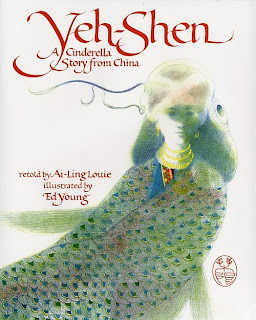
Yeh-Shen, retold by Ai-Ling Louie, is probably the oldest version we're apt to find. Unlike most other Cinderella tales that we're told, however, this one features a more ethical heroine. The reader doesn't pity her, but feels instead that Yeh-Shen truly earns the "happily ever after" based upon her actions toward others. This series of activity pages from abcteach.com assesses student understanding of sequencing, vocabulary, and story elements from Yeh-Shen.
Two others I'd recommend? If the Shoes Fits: Voices from Cinderella by Laura Whipple shares various perspectives from characters in our favorite fairy tales, all told in poem form. The Hummingbird King by Argentina Palacios is a South American legend with motifs we recognize from Cinderella, but with a terrific "flavor" of that continent.
Extension Activities

If you're looking for an interactive version of Cinderella, Annenberg Media provides an animated, narrated version of the most familiar retelling. But this retelling is actually just a small part of the Annenberg activity which is called Interactives: Elements of a Story. This self-guided learning module uses the traditional tale to help students understand Setting, Characters, Sequence, Exposition, Conflict, Climax, and Resolution. Each story element tests students along the way, and a summative assessment not only allows a teacher to see a student's overall understanding, but allows the students to revisit sections of the tutorial to self-correct missed responses. A very cool activity overall, appropriate for grades 3-5. Also be sure to see the Tips for Adults section of this site, which features links and extension activities for the Cinderella tale. (If you dig this site's format but you teach older grades, be sure to check out the Annenberg literature interactive for older students based upon Susan Glaspell's short story "A Jury of Her Peers").
Looking for an older, more "authentic" telling? National Geographic's Grimm Brothers site features the Grimm retelling of the Cinderella tale, which is a bit more PG-13 (for its gruesomeness). Older students might enjoy reading less "cuddly" versions of storybook favorites there.
Need more extension ideas?
If you're looking for a terrific collection of Cinderella books for your elementary curriculum, The Booksource has a nicely chosen set of fifteen Cinderella tales at a reasonable price. It includes many of the titles from above, plus others you'll want to explore.


 Posts


 . Author Kathy Ceceri includes myths from all around the world, grouping them by continents and cultures, and providing all the cool components that I've come to love in the Nomad titles:


