
Recent Posts

Showing posts with label CCSS. Show all posts

Thursday, April 2, 2015

Heroes of History, Part II

In an earlier post I shared how students used biography picture books to practice summarizing, recognizing opposing viewpoints, and citing textual evidence. Using the four-step process modeled there, students cut to the chase to tell what was "most needed to know" about their famous man or woman from history. So what's next?

Below I've shared some of the biography extensions and report options which students have completed over the years in my classroom. I'm sure you'll find a new one to try out!


Time Machine

As students read their biography, they take the usual notes, either on a prepared outline or free hand. When writing the report, however, the students pretend that they're able to travel back in time to interview this famous person. The most important details are then summarized in a question-answer format which reads in a more interesting way than a standard report. The paragraph students generated in the four-step summary process (above) serves nicely as the interview's introduction.


I've provided a sample of the interview format, but I highly encourage you to have students brainstorm their own interview questions as well. The brainstorming and sequencing process is an excellent introduction to the research process where students will need to formulate inquiries for themselves. Students will also discover that the unique experiences of any given person will in large part dictate the type of questions which should be asked. When reading Who Says Women Can't be Doctors? by Tanya Lee Stone, for example, one of my students was amazed to discover that Elizabeth Blackwell was turned down by twenty-eight different schools in her pursuit of attending medical school. "I think I would have quit trying after the first ten schools said no," the student remarked, and I wondered what Elizabeth Blackwell herself would have said to her in return.


Some years we presented these in a talk show format, with partners playing the role of interviewer, and other years students chose to dress as the person they were portraying. 


Journal

24 Ready to Go Genre Book Reports is a wonderful teacher resource full of ideas for responding to books, and one project from this resource which students have enjoyed is creating a journal.


When I first began teaching, I assigned students a similar journal format, requiring at least three entries that reflected events from the person's childhood or teen years, university or training years, and years of notable achievement. Additional entries could be written at students' discretion.


With the popularity of scrapbooking, students began asking if they could include artifacts in their journals. Projects soon included replica photos, sketches, tickets, maps, currency, and so on. The journal covers likewise became more creative, with students creating covers that resembled television sets, suitcases, trading cards, shipping crates, cars, space shuttles, hats, jerseys, and wanted posters. 

A wonderful set of biography books which rely upon a similar concepts of "snapshots" from a person's life is the 10 Day series by David Colbert, which so far includes books on Anne Frank, Abraham Lincoln, Thomas Edison, Benjamin Franklin, and Martin Luther King, Jr. If all students in your classroom read the same biography or autobiography, they could likewise focus on the ten most pivotal days of that person's life, with students possibly pairing up and writing a first-person account of one of these days.


As mentioned above, the paragraph students generate in the four-step summary process can serve as an introduction to the diary, as the entries themselves may not provide ample information for some readers to understand the importance of the subject's achievements.


Made in Quotes Cover
Lessons Learned

One of my students' favorite parts of the Time Machine assignment (above) is when they, in the guise of their famous person, are asked to give advice to future generations. Putting themselves "into the shoes" of this famous person and distilling the experiences of a lifetime into a bit of sage advice is a difficult yet rewarding task.


In Lessons Learned, students generate eight to ten tips that their hero might pass on to future generations. The advice can be published as beautiful quotes, using a quote making site such as Quozio, Quotes Cover, ReciteThis, or ProQuoter.


Here, the four-step biography summary is used as an introduction piece that acquaints the reader with the giver of wise counsel. The quotes themselves can be printed, or embedded into a Google Slides or similar sharing platform.


Timeline

Since most students best understand a biography in strict chronological order, creating a timeline would be a good way for them to explain and illustrate important life events.


For creating an online timeline, I highly recommend Hstry.co, which I discussed at length in a previous post. Check out that post to see how easy it is to get started with Hstry.


Telescoping Story


Telescopic Text allows writers a chance to share a story just one bit at a time, while revealing small and large thoughts alike in a measured manner. You can best understand this site by checking out the site creator's example. To see how a text is entered and edited, and to see a pretty impressive Telescopic Text created by a seven year-old, check out the video below.


Students could use this site to create a slowly expanding narrative of their hero's life. What's great about the site is that it encourages elaboration, a tough topic to teach students who are often trying to write as little as possible.


Caveat: Students should register for their own accounts and learn the difference between saving and publishing (saving allows for future edits; publishing does not).


Newspaper Clipping


A newspaper clipping describing an important event from a person's life is a terrific way to get students to focus upon what really merits attention. The Fodey Newspaper Generator provides a very short format clipping (about 1000 total characters), which is just enough to provide facts without the clutter of details. The clipping to the right, for example, was created in response to A Nation's Hope: The Story of Boxing Legend Joe Louis, written by Matt De La Peña and illustrated by Kadir Nelson. While the picture book chronicles Louis' rise as a fighter, the newspaper clipping captures just a highlight of that life.


This newspaper generator (which I found at the Learning Never Stops blog) allows for more space and also an image, but fills in the rest of the front page with two nonsense articles. Students would need to screen shot and crop out the other articles if they didn't want them to show.

In addition to a stand-alone activity, the newspaper clipping could also be used as an artifact in the Journal assignment above (some students have also used the movie clapboard generator at the Fodey site for their journal project). 


He Said, She Said 

I previously discussed Google Story Builder in another blog, and I'm still a fan. It's a very neat way to show differing points of view. Take a second to check out my review.  


Here's a short Google Docs Story I created after reading Mary Walker Wears the Pants: The True Story of the Doctor, Reformer, and Civil War Hero, written by Cheryl Harness and illustrated by Carlo Molinari. Note that activist Mary Walker disagrees with what a fabricated nemesis named "Nathan Properbody" has to say.

Students can create both sides of such a fictional dialogue, or two students can take on opposing roles and write from each viewpoint. The process will need some trial and error, and the resulting pieces can't be long, but it's a very different type of writing requiring some critical and creative thinking.

Looking for more tech tools to assess student learning? Be sure to check out this collection of over thirty of the best free sites I've found to assess students at all stages of learning process.

Sunday, February 16, 2014

Heroes of History

Read below for Marceau's amazing story!
One popular conversation in education centers around "What is worth knowing?" To that conversation I'd like to add the question, "Who is worth knowing?"

When I ask students to name someone famous and the first reply I hear is "Kim Kardashian," I die just a little bit inside. Students don't seem to have an understanding of, or appreciation for, the lives of great men and women who changed the course of history. 


But biography picture books can help to remedy that.


Wiser Words Were Never Spoken

My high school daughter recently took her SAT and was describing the writing prompt she was given. She paraphrased the quote and named the speaker (which I won't reveal here), and then described for me the way in which she had crafted her response. 

I finally asked, "And did you include why that quote was so important, considering the person who said it?" 

Her reply: "Well, I had heard of him, but I didn't really know who he was." 

Opportunity lost.

Regardless of what some might have us believe (the PARCC assessment comes to mind), historical context does, in fact, matter when examining any piece of text, and history is the product of those who made it.

Students therefore need knowledge of heroes of history.

Getting Started


Before showing students even a single biography, I gave them some practice summarizing current events articles from Tween Tribune using the tried and true 5Ws and 1H. This required a significant shift in students' responses; after all, I had been encouraging them for months to elaborate, and now they were being asked to summarize an entire article in a single sentence. 

The Tween Tribune article "It's Even Too Cold for Polar Bears!", for example, was summed up as follows:

Due to her specialized diet designed to eliminate a thick layer of insulating fat, Lincoln Park Zoo's resident polar bear Anana had to be moved indoors last Monday during Chicago's record-low temperatures.

Note that in addition to the basic facts, the sentence also provides students with a model for writing a cause/effect relationship.

After some independent practice with longer articles (requiring even greater ability to discern important facts), we were ready to move on to trade books. 

You may want to follow along on the assignment guidesheet which you're welcome to download in pdf (or Word) and be sure to grab the blank sheet as well (also available as a Word doc). You'll notice that the instructional steps below differ somewhat from those given to students for their own work.


Just the Facts
 
For my mentor text, I selected Robert Burleigh's George Bellows: Painter with a Punch!, in part because while George Bellows' art might be familiar to students, the man as an artist was not. I also planned to return to this text in a later lesson on using opposing viewpoints to construct argumentative writing.

In their notebooks, students jotted down a list of the 5Ws and 1H (Who, What, Where, When, Why, How) and were asked to listen for those facts as I read the book aloud. I read the majority of the book, stopping to monitor understanding and also to ask if any of our facts had been discovered.


By story's end we had 

Who: George Bellows
What: painted pictures that weren't beautiful
Where: New York City
When: early 1900s
Why: to show emotions and power
How: showing scenes of everyday city life

Cobbled together after some discussion and experimentation, these facts became a fact-fixing sentence that sounded like this:

In the early 1900s, George Bellows and other artists in New York City’s Trashcan School began painting pictures that showed the ugly, gritty, common scenes of the city in order to capture the emotion and power of everyday life.

Prove It!

Students knew that this was coming. What textual evidence backed up what we just stated? We found several sentences which might work, and finally settled on just a snippet of one quote, which we placed into a sentence that included both the author and book:


According to author Robert Burleigh in the book George Bellows: Painter with a Punch, Bellows thought scenes of everyday life were beautiful and was “determined to find them.”

So What?

But then I asked, "So what? Why did that matter?" And here's where students begin to see the light. Those people from history who changed the way others think, believe, or act tend to be those worth remembering. In the case of George Bellows, he and other students of Robert Henri went against the traditional belief that the artist's role was to paint what was beautiful. 

This led us to construct an opposing viewpoint statement to precede the summary sentence we had already drafted:

For centuries, most people believed that artists should focus upon what is beautiful and romantic, but one artist named George Bellows thought differently.


Legacy

This, naturally, led to the question of legacy. "What lasting impact did this person's life and work have upon us? Why should they be remembered today?"

I had to provide a bit of background here, discussing with students that at this time in history, many schools of art were wrestling with the role of the artist and the artist's responsibility to represent "real life." Eventually we came up with this closing sentence:

Artists of the Ashcan School helped others to explore "bold new worlds" while at the same time recording, in full color, what New York City looked like one hundred years ago.

Pieced together, the finished summary read as follows:

For centuries, most people believed that artists should focus upon what is beautiful and romantic, but one artist named George Bellows thought differently. In the early 1900s, George Bellows and other artists in New York City’s Trashcan School began painting pictures that showed the ugly, gritty, common scenes of the city in order to capture the emotion and power of everyday life. According to author Robert Burleigh in the book George Bellows: Painter with a Punch, Bellows thought scenes of everyday life were beautiful and was “determined to find them.” Artists of the Ashcan School helped others to explore "bold new worlds" while at the same time recording, in full color, what New York City looked like one hundred years ago.

An impressive summary once completed. But, could students could do it on their own?

Training Wheels

Armed with this model, students jotted down the sentence order in their notebooks as a quick reference:


I. Opposing Viewpoint 
II. 5Ws and 1H
III. Textual Evidence
IV. Legacy

Each student was then assigned a picture book biography from numerous examples chosen by the teacher. Some teachers might be surprised that students aren't allowed at this point to choose their own books, but I feel it's important that students approach the exercise with no preconceived notions about the person they're studying.

Students read the books for homework and completed the four step process outlined on the guidesheet. The following day they shared their first attempt with a classmate and made revisions based on that peer's feedback. I then had students switch books with any other student in the class apart from the one who had heard their summary. This guaranteed that by day three, two students would have read each book and could get together to compare paragraphs. This sharing led to much more productive revisions, as both students had intimate knowledge of the text and could offer more specific feedback on not only form, but also content.

I was surprised by students' success with the process. While some, as expected, followed the Bellows model precisely, simply swapping out details as needed, others departed from the model. A couple of students tried switching sentence orders when writing summaries of their second books, while others tried different grammatical structures while maintaining the sentence order we had established.


One student, not thrilled when handed Marcel Marceau: Master of Mime, was amazed to learn that this entertainer played a major role in the French Resistance, and led many Jewish children to safety. His paragraph, which he knew fell far short of paying homage to this unsung hero, reads:

Many people might think that miming is a fairly recent type of drama, but it is actually an ancient form of art that, because of sound movies, might have been forgotten; however, a talented young Frenchman named Marcel Marceau revived its popularity. After serving bravely in the Resistance against the Nazis during World War II, Marceau followed his dream of becoming an actor capable of moving the audience to laughter or tears, all without saying a word. According to author Gloria Spielman in Marcel Marceau: Master of Mime, "By the time he died in 2007, Marcel had revived the ancient and almost forgotten art of silence." Because of Marceau's work, many performers who followed in his footsteps realize that it isn't what you say, but how your facial expressions and body gestures convey it.

Most surprising to many students was how much they enjoyed reading about people they had never even heard of (many students had already made plans for the next book they wanted to read). The skepticism I witnessed on the first day when distributing books was replaced with enthusiasm by day two of the assignment. And since then, students have been asking to do the assignment again, and many have naturally been begging to read biographies of their own choosing.

So What's Next?

While this lesson can certainly stand alone as an exercise in summarizing, I can see these simple summary paragraphs serving as introductions to other types of responses to biography, current events, and history.

In my next post I'll share some possible extension activities, as well as some of the more popular titles which students enjoyed.

Tuesday, April 30, 2013

We've Got a Job: The 1963 Birmingham Children's March

"I want to go to jail," (third grader) Audrey told her mother.
Since Mr. and Mrs. Hendricks thought that was a good idea, they helped her get ready.

Cynthia Levinson's stunning and moving We've Got a Job chronicles the days leading up to the 1963 Birmingham Children's March. Read on to discover more about this historic event (and how you can win a copy of this book for your very own classroom).

In We've Got a Job, readers learn how young protestors, some just grammar school students, took to the streets in May of 1963 with the intention of filling the jails so that the segregationist policies of the South's most notoriously divided and violent city could no longer be carried out. For years Birmingham had seen vicious attacks on blacks, including countless fires and bombings, so many that the city was bitterly nicknamed "Bombingham" by its black residents. 


Too often, however, those of us who view history as an ordered series of dates in a textbook see the events of Birmingham as a given, as a struggle which was destined to take place. Little do most of us know how close the Birmingham protests came to utterly failing.

While many adults participated in sit-ins, marches, and public prayer meetings, it soon became apparent that retributions by whites, mostly through job loss, threatened to snuff the small flames of freedom before they ever caught. But encouraged by Martin Luther King, Fred Shuttlesworth, James Bevel, and others, children accepted the challenge and risked their own freedom and safety to do what had to be done. Facing the threats of dogs, high pressure fire hoses, and crowd brutality, children took a stand for those freedoms for which they can no longer wait.


Told through the eyes and voices of those who participated, this book brings a sense of intimacy and urgency which is often lacking in textbook accounts. Cynthia Levinson mixes personal narratives, historical background, contemporary anecdotes, and headlines of the time to create a well-rounded, highly readable account of extraordinary heroism by ordinary folk.

The Chain of Hate

Martin Luther King wrote:

"To retaliate with hate and bitterness would do nothing but intensify hate in the world... Someone must have sense enough and morality enough to cut off the chain of hate. This can be done only by projecting the ethics of love to the center of our lives."

And perhaps this defined the greatest challenge for the marchers: meeting hatred with love, violence with nonviolence, ignorance with understanding, intolerance with patience. What Levinson helps the reader to see is that the two sides weren't clearly cut; many whites sympathized with and supported the black cause, and many blacks disagreed with the nonviolent measures of the leaders of the protest movement.

One excerpt from Chapter Eight: May 2. D-Day describes the excitement of the children as they're carted off to jail in buses after they've filled all the police paddy wagons:

The kids were exhilarated; the policemen were exhausted. An officer asked a marcher, "When is this going to end?" 

She responded, "Do we have our freedom yet?"

"I wish you could have your freedom just to stop this," he admitted.

Later, at mass meeting in Sixteenth Street Baptist Church, King reassured hundreds of worried parents by saying:

"Your daughters and sons are in jail... Don't worry about them. They are suffering for what they believe, and they are suffering to make this nation a better nation."

The book concludes with an Author's Note, a map of the city, and a timeline of the events described in the book. These documents, as well as the book's final chapter, will help teachers answer the many questions that students might have about the Birmingham Children's March, and its outcomes on history.


Extensions and Recommended Resources:
  • One key to strong informational writing is the ability to blend exposition and narrative in a way that provides readers with information, while at the same time encouraging the reader to read on. Cynthia Levinson makes this happen through wonderful transitional phrases, the inclusion of headings, and a well-researched collection of quotes from the very people who lived the events. Many excerpts from this text could provide wonderful models for students to use in their own writing.
  • A study of Martin Luther King, Jr. would benefit greatly from this book, as it helps readers to see him as a very embattled, very conflicted, and very human figure. In the rear view mirror of history, we tend to see only the accomplishments and greatness of our heroes, and rarely their struggles. Students will be interested to learn that King faced disappointment, criticism, and failure; much of his greatness was his refusal to be defined or consumed by those same failings.
  • Peachtree Publishers has created a wonderful companion site featuring a synopsis, resources, and additional information about the players mentioned in the book. Also, be sure to check out the Official Blog Tour for this book. Every blogger has their own take, and lots more resources as well.
  • The Greensboro Sit-Ins are mentioned as an inspiration for the nonviolent restaurant sit-ins which took place in Birmingham. I've collected some wonderful picture book recommendations as well as several resource sites in a post titled Sit Down and Be Counted: Exploring the Civil Rights Movement with Picture Books.
  • If you're looking for a teacher reference, or a book appropriate for readers in grades 6 and up, I can recommend none more highly than A Dream of Freedom: The Civil Rights Movement from 1954 to 1968. Well organized by year and event, with plenty of period photographs, this is the book that will help you answer all of your students questions (and your own!) about this tumultuous and important time in our nation's history Author Diane McWhorter provides fact in a beautiful tapestry that reads like a story, full of real-life human beings whose individual stories form the larger transformation that we call The Civil Rights Movement.

Tuesday, March 12, 2013

Teaching That Makes Sense: An Uncommonly Good Resource

Years ago I first posted on Teaching That Makes Sense, founded by Steve Peha, an impressive web site full of well-organized, original resources on reading and writing.

They're all in pdf format and they're all free. And since the time that I first posted, Steve has added a ton of more stuff, again all free! He's added some fantastic new Common Core stuff (and love it or hate it, we've gotta face it) and according to the site's splash page, it's about to get bigger and better!


Is this guy insane? It would be easy to understand his generosity if the stuff was mediocre. But Steve has put together hundreds of pages of strategies, structures, checklists, and posters for teachers that are high quality, practical, and immediately usable.


Getting started in Reader's or Writer's Workshop? Looking for authentic student writing samples or mentor texts? Seeking sound ideas for writing across the curriculum? Need a writing lesson to use tomorrow? Want some posters for Writing Traits? It's all there. And if that's not enough, Steve and his crew are continually adding articles on the teaching profession that are truly worth a read.


And it's incredibly useful stuff, because the ideas are concrete (yet not closed-ended) and simple (yet not dumbed down).


So visit the site. Read the articles. Download the pdfs. Before Steve comes to his senses.

Sunday, February 24, 2013

The Secret to Descriptive Writing

Either I’ve encountered a conspiracy to confound teachers of writing, or I’ve discovered an “obvious secret” of descriptive writing. To paraphrase a classic School House Rock Video, it appears that verbs are, indeed, “what’s happening.”

I heard about the power of compelling verbs first from Ralph Fletcher in a visit to the Garden State. He explained that well-intentioned teachers encourage their students to use numerous adjectives to create interesting prose, which leads to detail-sodden writing which drags under its own weight. Simply unnecessary. In Ralph’s own words, “Nouns make the pictures, verbs make the pictures move.” (See my enthusiastic endorsement of a recent book by this author at the bottom of this post).

Flash forward to the New York State Reading Association (NYSRA) Annual Conference held in Saratoga Springs, New York (one of the best conferences I’ve ever attended). During the Author’s Progressive Dinner I had the pleasure of sitting with Steven Swinburne, creator of several wonderful nonfiction picture books including Lots and Lots of Zebra Stripes: Patterns in Nature and Turtle Tide: The Ways Of Sea Turtles. As he spoke with his guests about the creative process, he mentioned the importance of verb selection.

When I asked why he had mentioned verbs rather than any other part of speech, he quickly replied, “The correct verbs are essential. Verbs are the motor which drives the sentence.” Now I’m thinking that I’m on to something.

The following day I enjoyed a conversation with Steven Krasner, author of Play Ball Like the Hall Of Famers: The Inside Scoop From 19 Baseball Greats and Play Ball Like the Pros: Tips for Kids from 20 Big League Stars. Through his Nudging the Imagination workshop, Steve explained, he creates stories with students on-the-spot in order to model the writing process. “A huge key,” he explained, “is helping them to find the verbs to really move the story.” Opening one of his picture books, he pointed out he crafted the precise, vivid verbs of the final draft during the revision process, replacing common verbs which served only as place holders in the early stages.

If three very different writers can agree on the importance of verb choice, then I think there are some lessons to be learned by teachers of young writers:
  • Encourage students to examine verb choice in novels, poems, picture books, and informational texts. I choose existing mentor texts and  rewrite excerpts using “common verbs” (or, as Krasner would call them, place holders). Students are then challenged to replace these with more precise or colorful verbs.

  • Direct your students to consider verb choice in their own writing, and work to find action words that are more exact. As a start, outlaw there is, there are, there were, there was phrases. A better alternative always exists. As do exceptions. Remember the first line of Holes?

  • Teach children how to use a print thesaurus or online reference source (such as the Merriam Webster dictionary or Wordnik) for assistance in locating more exact expressions.
Recommended Reading

If you're looking for a resource to take your students' writing to the next level, check out Ralph Fletcher's Pyrotechnics on the Page: Playful Craft that Sparks Writing. Ralph explains the book's title by saying:

I am defining pyrotechnics as deliberate playfulness with language used by writers to create a particular kind of effect as well as the specific tools used to create that that effect.

The term includes (but isn't limited to) puns, invented words, allusions, idioms, metaphors, similes, hyperbole, onomatopoeia, and alliteration. (A good deal of the text discusses sentence structure, which is key to complex and elaborated writing as defined by the Common Core standards).


While at first these devices might seem like window dressing, realize this: your best readers can recognize these devices (even if not by name) and understand them in texts, which leads to improved comprehension. Therefore, giving students practice with literary devices in writing will not only make them better writers, but better readers as well.


Among a ton of other issues in this book, Fletcher discusses the need for writing teachers and student writers to switch from the what (subject/meaning) to the how (language), and he follows up with many ways to make this important distinction. And to prove his point, the author provides this lovely extended metaphor:

The purpose of a dinner party isn't merely to sate your guests' hunger - they could easily go to the local greasy spoon for that - but rather to take them on a gastronomic journey. Certainly you want the food to taste good, but it's much more than that You plan, prepare, and cook the food so that it has the proper texture, crunch, visual and flavorful variety. The spices should be in harmonious balance with each other. Writers know the same thing. If you want to make your writing memorable to readers, you must give them an aesthetic experience.

In another section called Shimmering Sentences by Other Writers, he talks about how's he fascinated by writers who violate common ideas about usage, and get away with it. Not just get away with it, but produce stronger writing as a result! See Breaking All the Rules of Writing at my How to Teach a Novel site which discusses how author Andrew Clements does exactly that.


If you still think that the books' about "play" and not about "practice," consider what not just Ralph Fletcher, but other experts, had to say:


...Language play carries the huge cognitive benefit of helping children become more efficient language users. Many educators have pointed this out, including Vygotsky, who famously described a child's language as "a head taller" during play. Jerome Bruner said that "language is most daring and most advanced when it is used in a playful setting."

And for those who prefer practice over theory, Fletcher includes a number of hands-on, ready-to-use-tomorrow resources here, including a Q and A section, craft lessons divided by grade level (K-5+), and a number of appendices which supply the teacher with loads of language exemplars, as well as recommended mentor texts.

I can't recommend this book too highly! Preview it in its entirety online at Stenhouse Publishers and see if you don't agree! But buy it on Amazon, save the shipping, and support this site!

Friday, February 15, 2013

Fightin' Words: Using Picture Books to Teach Argumentative Writing

So what's the difference between persuasive writing and argumentative writing? 

In persuasive writing, students passionately defend their point of view, relying upon opinion, personal experience, anecdotes, data, and examples. Argumentative writing, however, seeks to offer a more balanced approach, as it acknowledges points from the opposing view.

This approach may sound counterproductive; after all, won't writers weaken their arguments by providing the reader with counterclaims? Surprisingly, no. By naming objections and then refuting them effectively, writers actually strengthen the position of their arguments. Persuasion, on the other hand, is weak by comparison: it ignores, in a cowardly way, any viewpoint that is contrary and threatening to its own. It's blatantly one-sided and subjective.

So where can our young readers witness the power of argumentative writing? In picture books, of course!


In George Bellows: Painter with a Punch, author Robert Burleigh chronicles the career of a fascinating  and prolific artist who is celebrated for his gruff and gritty observations of the vitality and vigor of early twentieth century New York City. Burleigh provides the reader with "just enough" details of Bellows the man to make him real and rounded, and "just enough" context of the art scene of the time to build color and context. The majority of the text rightfully focuses on the images (profusely provided in beautiful color) and on Bellows' artistic legacy. 

As a teacher of reading and writing, I am struck by Burleigh's use of argumentative text structures which can serve as wonderful exemplars for young writers. Consider this passage from early in the text:

One man - seated at ringside - observes the events somewhat differently. He watches closely both the fury of the fighters and the fans' reactions. But who wins the bout doesn't matter to him. He has his own goal: to wrestle a picture from the chaotic scene, to capture the wild energy of this moment!

Is this strange? An artist here, in a smelly, grungy saloon?

Shouldn't an artist be searching for beautiful things to paint? Golden sunsets? Quiet, tree-lined rivers? Or perhaps a wealthy gentleman, or a celebrity dressed in her finest clothes? Many people would say just that.

But not George Bellows.

In that example, a series of questions defines the opposing viewpoint. We know that George will need a pretty darn good reason for choosing subjects so contrary to those of traditional artists!

In another selection, the opposing argument is presented more traditionally as a juxtaposition of one perspective to another:

George's paintings gain attention. He is among a group of artists who focus on the less romantic parts of the city, like bars, train stations, movie theaters, and alleyways...Reviewers attack the group, calling them "apostles of ugliness" because they dare to paint the seamier side of life...But a few reviewers find complimentary things to say about George's art. They especially praise his ability to convey strong feelings in his work.

One critic, although won over by Bellow's radical approach, still qualifies his admiration for the artist in a compliment that acknowledges the two opposing viewpoints of the time:

"It's in bad taste," one says, "but it's life - and that is the main thing."

As you can see, the examples of argumentation are there. They're subtly written, however, so as not to crowd out the narrative. That is exactly what makes them effective, and so worthy of our students' admiration and study and replication. 

In the excerpt below, note that the first two sentences juxtapose opposing viewpoints, with the word yet being the giveaway. The second pair of sentences follows the classic "some people say ______, but _______" format, with though serving in place of but:

"I don't know anything about boxing," he likes to say. Yet the paintings he makes based on these fights will become his best known works. Some critics note that the figures in the paintings are awkwardly drawn or that the ringside spectators have odd, caricatured faces. What concerns George most, though, is creating a "you-are-there" feeling.

Can students incorporate this same argumentative style into their writing? Absolutely. The key, in my opinion, is starting with some great exemplars. The next step is getting students to see that argumentative writing often relies upon a fairly standard set of sentence structures. This "sentence grammar" is more common in writing than you think!


Consider these templates:

  • At first you might think _____, but _____.
  • While it's true that _____, you need to remember that _____.
  • It's possible that _______, but __________.
  • Some people believe that _____; however, _____.
Here are those same templates, reworked with spelling words:

  • At first you might think that vivacious children are wonderful, but after three hours you would find them to be very exhausting.
  • While it's true that vitamins are part of a healthy diet, you need to remember that they can't take the place of nutritious foods.
  • It's possible that coffee increases vitality, but it's still no substitute for a good night's rest.
  • Some people believe that bees are attracted to sugar; however, bees are equally attracted to vivid colors.

Somewhat better than what students typically produce, right? But with the models, it's possible.

And again, those same templates as part of an expository paragraph about common misconceptions of the Holocaust, based upon a reading of An Introduction to the Holocaust for the Young Reader:

At first you might think that World War II caused the Holocaust since the two events are mentioned together so often; after some study, however, you would find that persecution of Jews in Germany began six years earlier. And while it's true that six million Jews were exterminated by the Nazis, you need to remember five million others who were considered undesirable were killed as well. It's possible to believe now that people should have stepped in to save the Jews, but you'd be surprised how few countries seemed to care at the time. You might think the United States was the exception, that we cared enough to step in; however, of the thirty-two countries that attended the Evian Conference, only one chose to accept Jewish refugees, and it wasn't the United States.

A perfect paragraph? No. But one that shows a balanced consideration of ideas; one that acknowledges common misconceptions, and then dispels them, one at a time.

Extensions:
  • Share George Bellows: Painter with a Punch with students, reading through from beginning to end for the sheer enjoyment of the narrative and images. Show students additional Bellows' paintings in over-sized library books or online. I prefer using images online, as I can often resize them on-screen to match their approximate real-life sizes.
  • Reread selections from the text in order to discuss the use of opposing viewpoints. Why does the author include them here? In what way is this text argumentative? How does mentioning the opposite viewpoint strengthen each point that author Robert Burleigh makes? 
  • Once students have discussed some text selections, work with them to identify the "skeleton" or "template" of each argumentative structure. Then, supply students with new content to be rephrased in argumentative format using the author's exemplars. One example from above reads, "Some critics note that the figures in the paintings are awkwardly drawn or that the ringside spectators have odd, caricatured faces. What concerns George most, though, is creating a "you-are-there" feeling."  This excerpt relies upon the "Some people..." format, with the counter-punch statement using "though" to express opposition (however could have been used as effectively as though).
  • Discuss the book's title with students. Some students will notice that the subtitle is alliterative, in that words share the same beginning sounds. If your students have recently read biographies, challenge them to write fictitious subtitles that rely upon either alliteration, rhyme, or word play. (Other students will notice that the top rope of the ring serves to underline the book's main title).
  • Show students other nonfiction books which utilize a title and subtitle, and discuss this feature's purpose. Authors and editors may do write titles in this manner for many different reasons: to separate their book from others on the same topic, to add a creative twist while still keeping the main topic "out in front," or to provide prospective readers with the book's focus (for example, Abraham Lincoln: A Pioneer Boyhood is aimed at a different audience than Abraham Lincoln: Making of a President). 
  • Require that students use sentence stems (aka templates, models, patterns) such as those above to contrast simple ideas. Start with simple single sentences, move to paired sentences, and finally to paragraphs. My own students have used them for lesson summaries, spelling sentences, responses to current events, summary paragraphs (such as the Holocaust piece above), and comparison/contrast writings about character motives.
  • Check out this fantastic break-down of argumentative writing from Smekens Education Solutions, Inc. In addition to some teaching tips, you'll find a ready-to-go activity that challenges students to identify what makes a revised piece of writing argumentative. They've also produced a clever student friendly/teacher friendly interpretation of the ELA Writing Standard (6.1) for Text Types and Purposes.

Recommended Reading

If you're looking for a single, go-to title for working with argumentative text models like those above, check out They Say, I Say: The Moves That Matter in Academic Writing. This book explains in clear words, dozens of templates, and numerous real-world examples the powerful concepts which guide argumentative writing.

Here you'll find templates for openings, closings, discussion, disagreement, etc. You'll also have at your fingertips many professionally written articles, essays, and speeches which show these same templates at work (check out the explanation of argumentative writing in Martin Luther King, Jr.'s Letter from Birmingham Jail shown in the book preview on Amazon). 


This work, aimed at both instructors and high school- and college-aged students, is must reading.


Sunday, February 3, 2013

Animal Attraction: Exploring Animals with Picture Books


Children love animals, so it's not surprising that the canon of children's literature is populated with iconic rabbits, bears, elephant, and mice. So how can we continue to take advantage of this connection with animals as students enter their upper elementary and middle school years?

Below I've listen ten ideas for making the most of students' animal attractions. Feel free to leave a comment to share how you've used animal books in your own classroom.

1. Fantastic Fables
Project Type: Creative Writing
Suggested Grades: 2 and up

The Ancient Greeks understood the power of storytelling for instructing youth. Traditional ancient fables typically feature animals acting with human traits (anthropomorphism) and conclude with a moral, whether explicitly stated or not. 

A popular version of this genre is Aesop's Fables by Charles Santore, a reinterpretation of twenty-four of the illustrator's favorites, told and illustrated in a classic manner. My favorite illustration depicts "The Hare and the Tortoise" in a trifold page, featuring the entire cast of animals posed against a rolling landscape forested with crumbling Greek pillars, witnessing the triumph of the Tortoise. In choosing the tales and creatures to include, Santore explained:

"Each animal - the wolf, the clever fox, the silly crow - represents and symbolizes some particular aspect of the human condition. Whatever the situation, the animal's reaction is always predictable. This is true of all the creatures that populate the fables, and they never disappoint us. They are never more or less. That is the great lesson and the essence of the fable."

One modern take on this topic is Arnold Lobel's original Fables, told in plain English with the morals plainly stated. A lesser known but entertaining new look at fables can be found in Yo, Aesop! Get a Load of These Fables by Paul Rosenthal and illustrated by Marc Rosenthal. Each of these thoroughly modern fables in presented in a tongue-in-cheek way, followed by a critique and commentary by Aesop himself.

Classroom Extensions:
  • After reading several fables, ask students to describe which human traits are typically assigned to which animals. Why these animals? What is it about their physical traits or behaviors that makes them deserving of these attributes? Challenge students to assign human traits to some animals not traditionally seen in fables.Then ask, "If you were depicted as an animal in a fable, which animal would you be? Why?"
  •  Provide each student with a moral. Using one of your own, model how a story might be created to illustrate its lesson. Challenge each student to choose a cast of animal characters and write an original fable (they could even include themselves from the activity above). Need some moral ideas? Check out American English Proverbs for some thought-provoking lines. 
  • Select an illustration from one of the books described above. Challenge students to write the fable it illustrates. Another terrific source for traditional fables is Jerry Pinkney's Aesop's Fables.
  • Squids Will Be Squids is Jon Scieszka and Lane Smith's collection of fantastically original fables. Check out the related teaching ideas at Scholastic.
2. Peerless Predators
Project Type: Argumentative Essay/Research
Suggested Grades: 4 and up

Animal research projects are so common as to be cliche. So much of what we call "research" amounts to simple regurgitation of facts that are, in isolation, somewhat meaningless. So how can we revamp this assignment to make it more meaningful for students and their audience alike? I suggest an assignment called The HOWL Museum.

To practice argumentative writing skills, students are told that the HOWL (Hunters of the Wild Lands) Museum is seeking nominations for predators to be included in their exhibits. In order for a predator to be selected, students need to prove that their nominee is a well-equipped and skilled hunter. Students are then assigned predators for research, and they begin to organize initial ideas on a Google Drawing doc template (notes could also taken using Read Write Think's Persuasive Map). 

While students used several Internet sources for research on this project, many students used trade books as well. One favorite was Predators by John Seidensticker and Susan Lumpkin (one of the INsiders series published by Simon and Schuster), as it featured not only profiles of some of the world's top hunters, but also sections on the weapons and instincts that make these killers the pinnacles of their food pyramids. The text reads like any excellent nonfiction text, with plenty of illustrations, captions, text boxes, and cut-away diagrams.


Top 10 Worst Killer Animals You Wouldn't Want to Meet by Fiona Macdonald and David Antram boldly counts down the top killers from around the world, providing curious readers answers to questions such as, "How do jellyfish feed?" and "How do you avoid a shark attack?" Kids find this book fascinating since it profiles not only the predators, abut also those malevolent creatures that carry infection and kill by disease.

But perhaps the hottest commodity was Predator Showdown: 30 Unbelievably Awesome Predator vs. Predator Faceoffs by Lee Martin. Students loved the grudge-matches depicted on the pages, along with the vital stats of each contender. Rather than reveal the winners immediately, the author lists the winner on the book's final page, along with a short explanation of why one animal would overcome the other. I think students enjoyed the format because its competitive nature mirrored the fierce loyalty they began to feel for their own nominee to The HOWL Museum. Unfortunately, it seems that book is out of print, so if you can't find it at your library I'd alternatively suggest Nature's Deadliest Predators by Shelly Silberling. While it is limited to sharks, bears, tigers, and alligators and crocodiles, this text demonstrates the interactions between these predators and the humans who increasingly compete with them for limited habitable space.


Classroom Extensions:
  • Assign each student a predator, and direct them to learn about that animal's physical traits and behaviors. 

  • Use a simple checklist to allow students to peer review first drafts. One of our checklists can be accessed below. Click on the icon on the lower right corner to see this document full size.

  • Publish the essays and post them with an announcement about the HOWL Museum. To create the illusion of a grand opening, I used the image editing site Photo505 to create some "publicity shots." To this day, some students think the museum is real! See the photos below, and feel to use them as well.
  • If you're not crazy about the notion of predators, consider research projects on animals that live in productive harmony through symbiosis, a "close, prolonged association between two or more different organisms of different species that may, but does not necessarily, benefit each member" (wordnik.com).

3. Crazy Critters
Project Type: Creative Writing/Art
Suggested Grades: 2 and up 

Kids love the idea of mixing and matching animal parts! Explore some picture books that celebrate these crazy mixed up animals, and then let your students loose to give it a try themselves. 

In Scranimals, written by Jack Prelutsky and illustrated by Peter Sis, animals are not only combined with other animals, but with fruits, vegetables and flowers as well! Thus we get spinachickens, broccolions, and bananacondas. Fun poems accompany each full spread illustration. In Animals that Ought to Be: Poems about Imaginary Pets, Richard Michelson and Leonard Baskin exercise equal creative liberties in morphing creatures that are both creepy and utilitarian, such as the Nightmare Scarer which feeds upon bad dreams. In a third book of poems, author Keith DuQuette offers up some hilarious homemade hybrids in Cock-a-Doodle-Moo: A Mixed Up Menagerie.

Classroom Extensions:
  • Explore the concept of portmanteau words with your students. Unlike compound words that simply combine two smaller words, or contractions which drop letters, portmanteau words combine words and lose letters to form new words entirely. Thus smoke and fog create smog, and breakfast and lunch create brunch. Scranimals is a terrific choice for introducing this concept.
  • Have students cut apart magazine images of animals to create collage critters. Students can then write descriptions of these animals, including the unique abilities they're granted given their hybrid qualities.
  • Explore the online possibilities for creating crazy animal combinations using a site like Switch Zoo or Build Your Wild Self.

4. Beasts of Burden
Project Type: Creative Writing/Research
Suggested Grades: 3 and up 

In addition to language and the wheel, perhaps nothing defines human evolution more than the ability to domesticate animals. In fact, according to Keltie Thomas, there are some Animals that Changed the World:

From furry felines to hard-working horses, animals have had a tremendous impact on world history. For example, rats, through the diseases they carry, have probably killed more people than any war or natural disaster, goats may have been the first to discover coffee and, thanks to camels, people were able to survive for long periods in the desert and open up trade routes between Europe and Asia.

In this amazing book, the author describes how 20+ animals have had a profound impact on human history for good (dogs, camels, horses) and bad (rats, mosquitoes). A fascinating nonfiction read for the students 10 and up, this full-color text features photos, diagrams, maps, and timelines, paired with easy-to-understand text. Overall the information is organized by topic (Animals at Work, Secret Agents of Disease, etc.) and also by individual animal. See some sample pages from publisher Annick Press.

If you're interested in getting "up close and personal" with some amazing animals who have found their ways into our human history, check out Tales of Famous Animals by Peter and Connie Roop, illustrated by Zachary Pullen. These true tales tell how amazing animals, from the time of Alexander the Great to the present, have played critical roles in the lives of humans they've encountered. Find familiar names like Koko the Gorilla and Smokey Bear, and not-so-familiar names such as Quest and Old Abe. While some critics may argue that animals serving humans are in bondage, this book clearly illustrates that affectionate and respectful relationships between humans and animals are mutually beneficial. Highly recommended as a read aloud!

In addition to working with humans, younger readers may also be interested to learn how animals work together. In Do Animals Work Together?, author Faith Hickman Brynie describes the many ways that animals communicate among their colonies, packs, and herds. What's neat about this book is that each spread features a picture page and a text page, with the text page containing new reader sentences at the top, providing basic information, and a fluent reader section at the bottom, providing more details. One text section isn't dependent upon the other, and both can be read without sounding redundant. Enslow Publishing provides an educator 's guide for this book, as well as all books in the I Like Reading About Animals series. (Win this book! See bottom of the post).

Classroom Extensions:
  • Assign each student an animal that has played a significant role, for good or bad, in human history. After they've researched their animal, allow students to present to the class in a creative way. For example, what would each animal have to say about its life's work in a retirement speech? Would it be proud of its accomplishments?
  • Using Animals that Changed the World and other resources, students can practice writing simple expository essays describing how animals assist people. While children can likely generate three ways that dogs are useful to people, including a resource text reinforces the the importance of backing arguments with facts and quotes.
  • Pair individual accounts of animal labor from Animals that Changed the World with related fiction texts (for example, real-life sled dogs paired with Stone Fox) or related nonfiction texts (camels and their role in the Silk Route).

5. Creature Comparisons
Project: Poetry/Figurative Language
Suggested Grades: 3 and up

Curious as a cricket, happy as a lark, slow as a snail. See where this is going? Students enjoy creating simple similes, and their vast store of animal knowledge makes these comparisons easy.


A wonderful mentor text for this activity might be Shakespeare's Zoo (Volume 1) by Laudea Martin. It was "a very old (c. 1896) and well-loved boxed set of the complete works of William Shakespeare, which once belonged to Laudea's great grandmother... that sparked her interest in the richness of Shakespeare's written words." The author soon discovered that in many of Shakespeare's works, both famous and obscure, the Bard employed animal imagery to paint perfect pictures of human passions and pratfalls. 

From the book description:
Shakespeare's brilliance shines through, not just in his most famous lines, but in every line. The tiniest snippet of his work contains fantastic wordplay and depth of imagery. This book takes some of his less-known bits about various animals and pairs them with Laudea Martin's unique illustrations assembled from textured layers.

And, like all Shakespeare, each page will become easier to understand the more you read it. The brilliant words of Shakespeare are meant to be heard, not seen, so read the words aloud and listen to the rhythm. Read them again and again, and let your imagination fill in the details of the scene.

Each illustration was digitally constructed using layers of textured color. Some textures will be immediately recognizable, such as wood grain or leaves; others may be more difficult to discern, but all come together to create whimsical representations of just a few of the animals mentioned by Shakespeare.

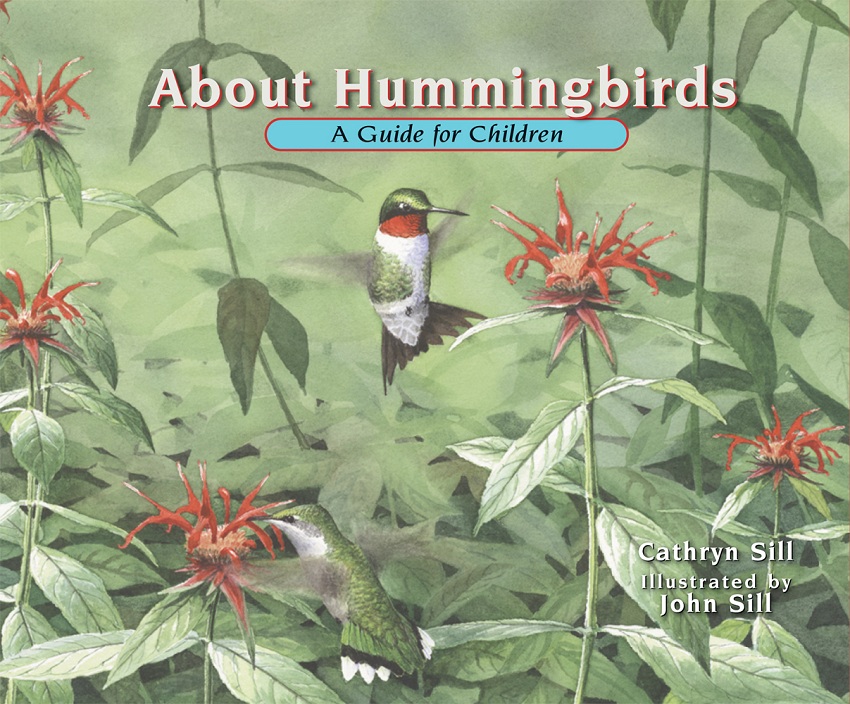
Simple nonfiction picture books can provide students with countless ideas for writing about their own traits. In About Hummingbirds, for example, author Cathryn Sill discusses in plain language how hummingbirds are brightly colored and fast (we knew that!) while at the same time stealthy and even quarrelsome! Illustrator John Sill's images back up the text with vivid details, showing the reader in fine detail what could never be seen in real life by the naked eye. 

For students seeking more details, the creators included a plate-by-plate addendum providing more data about each image, including information on habitats, physical dimensions, and behaviors, with rich words such as iridescent, preening, and vigorously. See other books in the award-winning About... series, or Win this book! See bottom of the post for more information. 

Classroom Extensions:
  • Students can create biographical poems by first selecting adjectives that they feel describe them (pretty, busy, fast, etc.) and then selecting animals that match those adjectives. Students can pair the adjectives and animals in simile form, such as, "I snore like a lion when I'm really, really tired," and "I'm busy as a beaver every day when I get home."
  • Creating a flip book is a fantastic way to show off and illustrate the comparisons described above, and the sizes of the books can vary from tiny to huge.
  • Collect a pile of animal poem books and let students browse them and share their favorites. Then offer trade books or simply pictures of an assortment of animals, and ask students to write simile poem inspired by a favorite critter. 

6. Pack Behavior
Project: Analytic Essay/Novel Extension
Suggested Grades: 5 and up
 
We all know that wolves and dogs are pack animals, but did you realize that humans are as well? If you don't believe me, ask Cesar Millan, who in Be the Pack Leader has this to say:

The power of the pack idea doesn't just apply to dogs. It applies to another species of pack animals whose destinies have been intertwined with those of dogs for tens of thousands of years.That would be our very own species, Homo sapiens.

I've had a good deal of success with partnering books on wolf pack behavior with books that deal with similar "pack" behavior in humans. Holes, The Outsiders, Wringer, and Lord of the Flies are just a few of the books that demonstrate the irresistible hold a dominant alpha can have over a pack, leading subordinates to follow blindly, even when consequences might prove disastrous. The boys of Group D in Holes, for example, certainly adhere to a ranking system, and protagonist Stanley Yelnats quickly learns that small concessions on his part can improve his own position in that ranking. 

And of course, I'd recommend a quick study in pack behavior before reading any novel dealing with dog packs, such Island of the Blue Dolphins, Julie of the Wolves, and Call of the Wild, to name just a few.


For picture books I would recommend Scruffy: A Wolf Finds His Place in the Pack by Jim Brandenburg,  Wolves by Sandra Markle, and Face to Face with Wolves, also by Jim Brandenburg.


Classroom Extensions:

  • Choose a fact-rich picture book such as Scruffy: A Wolf Finds His Way in the Pack. Once students have read and discussed the text, have them write a simple essay explaining how pack behavior is critical to survival.
  • Later, assign students the challenge of drawing comparisons between the group behavior observed in your novels and the previously studied pack behavior.

7. Feathered Friends
Project: Poetry/Research
Suggested Grades: 5 and up 


Screenshot of a LinoIt discussion of Dunbar's The Sparrow (see below)
In his classic poem The Raven, Edgar Allan Poe describes the unsettling midnight visit of a raven to the windowsill of a melancholy and mournful narrator. When that narrator asks repeatedly if the raven will provide solace and comfort, the raven simply answers, "Nevermore." Similarly, poet Paul Laurence Dunbar is visited by a sparrow who, unlike Poe's raven, seems to offer reprieve from the author's toil and dullness. The sparrow's attempts to distract the poet are rebuffed.

If you suspect a theme is developing, you would be correct. Poets in particular seem to enjoy expounding upon serendipitous meetings with birds, taking some delight in reading their stoic expressions and wondering about their mysterious lives (see Emily Dickinson's A Bird Came Down the Walk, Paul Laurence Dunbar's The Sparrow, and Edwin Morgan's A Gull).

Classroom Extensions:
  • Share some of these poems with students, particularly Edgar Allan Poe's "The Raven." This poem's fantastic vocabulary, figurative language, and creepy author's tone can be explored interactively The Interactive Raven and Knowing Poe: Annotated Poe.   
  • Compare and contrast Poe's poem with others about chance meetings with birds. This post discusses using a cool collaborative site called LinoIt to create online discussions, complete with stickies, images, and videos.
  • Assign each student a bird, asking them to explore its history and mythology, as well as its physical characteristics and habits. Armed with this information, challenge students to write a poem about a meeting with this bird, basing it upon some of the exemplars above.
  • Check out the haunting poem Carrion Crow by John Heath-Stubbs (definitely share the audio!), which describes a literal bird's eye view of history. After discussing the text and researching the battle to which it refers, ask students to write a similar poem as observed from a bird's point of view.
  • If you feel that this activity is for the birds, consider allowing students to write poetry about their own choice of animal after conducting some basic research. Eric Carle's Animals Animals features animal poems by some of the literary greats (think Kipling, Carroll, Sanburg, Rossetti) accompanied by his signature cut-paper illustrations. These poems might also serve you if you choose to tackle any of the Creative Comparisons activities listed above.
8. Who's to Choose When It Comes to Zoos?
Project: Argumentative Essay/Research
Suggested Grades: 6 and up

Should zoos exist? The SCAN post titled Simple Questions Lead to Complex Learning is a good jumping off place for getting started with this topic (as well as many others).

For ages 8 and up, the dilemma of animal captivity is thoughtfully explored in Katherine Applegate's The One and Only Ivan, the 2013 Newbery Winner. From the Author's Biography: Katherine was inspired to write The One and Only Ivan after reading about the true story of a captive gorilla known as Ivan, the "Shopping Mall Gorilla." The real Ivan lived alone in a tiny cage for twenty-seven years at a shopping mall before being moved to Zoo Atlanta after a public outcry. I highly recommended this text as a read-aloud, or as a class novel for grades 4 and up. Check out the official book trailer below.

Classroom Extensions:
  • Let students explore a number of zoo and circus themed picture books. What messages about zoos and their purposes seem to be conveyed in those texts? Have more recent titles on these topics attempted to redefine the roles of these institutions?
  • Assign students to prepare both pro and con arguments for zoos, and then divide the class arbitrarily to debate the issue.
  • Upon the debate's conclusion, invite students to write an argumentative essay for the position they would like to take, being certain in their writing to address the claims of the opposing viewpoint.
9. Animal Allies
Project: Art/Research
Suggested Grades: 5 and up

Animal Tribe introduces students to the mythologies and wisdom of animals as celebrated by various indigenous peoples from around the globe. Explore that site to see what's offered, and consider ways that these studies could be incorporated into your existing curriculum.


A logical connection to this project is research in how animals are being threatened by their struggles to share this planet with humans. Books such as Once a Wolf: How Wildlife Biologists Fought to Bring Back the Gray Wolf by Stephen R. Swinburne and Dorje's Stripes by Anshumandi Ruddra can get this discussion started.

In the latter book, a beautiful Royal Bengal Tiger arrives one day, broken and tired, at a small Buddhist Monastery in Tibet. He begins to lost his stripes as his fellow tigers are poached from the surrounding countryside. Hope for the future shines, however, when one day a single stripe, and a beautiful female tiger, return. ((Win this book! See bottom of the post).

Classroom Extensions:
  • Visit Animal Tribe and see how that site's activities can be adapted to your lesson plans.
  • Rather than traditional animal research projects, assign each student an animal that is threatened or endangered. In addition to describing the causes of their animal's predicament, they should offer possible solutions that serve all parties involved.
  • In connection with a text such as Once a Wolf, appoint students to play various roles including ranchers, conservationists, tourists, etc. Plan a debate with each interest group required to provide support for their point of view.

10. Home Sweet Home
Project: Creative Writing
Suggested Grades: 2 and up

Almost every child at one time or another has dreamed of owning an exotic pet. Many books have explored the possibilities and pitfalls of this fantasy. Perhaps the most well-known of this genre is The Salamander Room by Anne Mazer. In this simple yet beautiful story, a child patiently counters his mother's every protest against his plan to adopt a salamander and transform his bedroom into a forest refuge. The question-answer format of storytelling is a familiar one, but the facts we learn about salamanders and the illustrations by Steve Johnson are alone worth the price of admission.

Not Inside This House! written by Kevin Lewis and illustrated by David Ercolini, addresses this same topic in a much more humorous way.

A curious boy named Livingstone, who finds ordinary toys and diversions a bore, loves to explore. To his mother's horror, however, he enjoys bringing the results of those explorations home. From the book:

His wary mom?
She did implore...

"Livingstone Columbus Magellan Crouse,
I'll have no bugs inside this house!
I'll say it once. Won't say it twice.
To speak again will not suffice."

As you can see, Kevin Lewis' text is replete with wonderful words, and David Ercolini's vivid illustrations beg closer inspection. See more here at the artist's site.

Classroom Extensions:
  • Play devil's advocate using The Salamander Room. Is it right for Brian to keep this wild creature in his home? If the salamander's comfort demands so many changes to Brian's room, then is this the best place for it?
  • In Not Inside This House, the pets Livingstone chooses to bring home become increasingly large and troublesome. When his mother finally relents and agrees that he can have the one bug he started with, we have to wonder, Is this what he had planned all along? Have students choose an extraordinary animal they'd like to adopt, and then create both sensible and outlandish reasons they'd give for why this animal should be permitted.
I hope this list gives you a few ideas to try out in your classroom, as well as a few new titles to add to your library! Please comment below and share with your fellow readers how you use animals books in your classroom.