Recent Posts

Showing posts with label teaching with picture books. Show all posts

Tuesday, March 15, 2011

I Can Write Like That: Focusing on Mentor Texts

If you're here at this site, you're most likely interested in teaching with picture books. You recognize that these models provide excellent examplars for word choice, idea development, story structure, and many other skills and traits.

In fact,


You know the importance of using mentor texts when teaching author's craft to your young writers. But how do you- a busy teacher with only so many hours in a day - find great mentor texts? With so many children's books available and so little time to peruse them all, matching books to writers' workshop mini-lessons remains a challenge.

That challenge is met in I Can Write Like That! A Guide to Mentor Texts and Craft Studies for Writers' Workshop, K-6, an International Reading Association title by Susan Ehmann and Kellyann Gayer.

The excerpt above appears on the book's back cover, along with this:


In these pages you'll discover engaging fiction and nonfiction children's books and ideas for using them to their maximum potential as teaching tools. And you will find new ways to give your students a priceless gift - exemplary models for their own writing. Realize the reward of having your students listen to a well-written story then identify the author's craft and say, "I can write like that!"

Four years in the making, I Can Write Like That! serves as an invaluable resource if you're seeking to accomplish the following:
  • Build a library of mentor texts;
  • Uncover all that you can teach from each book in your growing mentor library, whether it be from an old favorite or a new discovery;
  • Find the perfect mentor texts to teach specific craft elements; or
  • Locate age-appropriate craft studies that support your writing curriculum and further serve as models as you develop craft studies of your own. (pp. 5, 6)
I was frankly surprised to see that half the book consists of annotated lists of picture books; upon closer inspection, however, I realized that this feature makes sense. So many teachers in workshops have come to me and said, "I have so many of those books in my classroom library, but I never really knew before how to use them for instruction," or, "I want to create a core collection of really great books, but I don't even know where to start."


My wife, a kindergarten teacher, confirmed the value of the lists. As she looked through the annotations, she remarked, "This is pretty cool. If you already own one of the books, you can see what skills to focus on. Or if you want to teach a mini-unit on a single skill, such as repetition, you can use the chart and choose books from there."

The straight-forward organization of the book allows teachers to easily locate exactly what they're looking for:
  • Part I: Craft Elements provides detailed descriptions and teaching points for working with craft elements such as alliteration, breaking the rules, flashback, leads, personification, text features, and voice, a surprising twenty-seven craft elements in all.
  • Part II: Selected Craft Study Lessons features sample lessons, providing teachers with models for their own instruction.
  • Part III: Mentor Texts to Demonstrate Craft Elements contains an expansive matrix, aligning hundreds of new and classic picture books with the twenty-seven craft elements, followed by a through breakdown of these books by element (see figure to the right).
  • Two Appendices feature student recording sheets and additional reading lists for teachers.
You and your colleagues will refer to this resource again and again. 

Friday, January 28, 2011

Great Minds Thinking Alike: Sites for Teaching Using Picture Books

I founded this humble blog for the purpose of sharing picture book teaching ideas with my fellow teachers. I frankly wasn't able to find anything like it on the Internet.

Since that time, many teachers have emailed me to say how much they appreciate the recommendations and resources found here. Many, however, are hungry for more, and invariably ask, "Where can I find other sites like yours?"

To advance the cause of teaching with picture books, I reached out to some of the extremely knowledgeable and talented educators who, like me, not only review children's books, but also provide their readers with teaching ideas and additional resources. I absolutely encourage you to visit their sites, become followers, and share their resources with your colleagues.

In addition, if you know of a fantastic site that I missed (especially if it's yours!) please let me know and I'll be sure to include you here.


The Book Chook
Audience: Teachers, Parents, Homeschoolers, Anyone Who Loves to Read, Write or Create and Wants to Share that with Kids.

Teachers and parents from all over the world visit The Book Chook to find tips on encouraging kids to read, write and communicate, reviews, letters asking for The Book Chook's advice, articles about using technology to motivate kids' learning, and links to games, activities and online fun.
Susan Stephenson is the face behind The Book Chook, where she shares her passion for children's literacy, literature and learning. Susan taught Kindergarten to Year 6 in Australian primary schools, drama outside school to kids and young teens, and ESL in China.

Currently, as well as pretending to be a chicken on her blog, she writes stories for children, and edits the free magazine for parents, Literacy Lava. It's published four times a year, and available as a downloadable free pdf. Each issue is erupting with practical ideas and strategies to involve children in reading, writing and communicating with creativity. Contributors come from all over the world, but each shares a passion for children's literacy.

Some recommended posts to explore:

Katie's Literature Lounge
Audience: Teachers, Parents, Homeschoolers, Librarians

In discussing Katie's Literature Lounge, Katie had this to say:
I am an elementary Head Start teacher by day and a reader during any/all free time. Being a teacher I am always looking for children's books to read and use in the classroom.
This blog provides readers with books (mainly picture books for children between the ages of 3-10) and if possible, lesson plans and reading activities to match. Feel free to steal the ideas for your own classroom, reading group, library or children!

Margo Dill's Read These Books and Use Them
Audience: Teachers, Parents, Homeschoolers, Librarians, Children's Writers

Margo L. Dill is a freelance writer, editor, and teacher, living in Mahomet, Illinois. Her work has appeared in publications such as Grit, Pockets, True Love, Fun for Kidz, Missouri Life, ByLine Magazine, and The Chicago Tribune. She is a columnist, instructor, and contributing editor for WOW! Women On Writing. She is assistant editor for the Sunday Books page in The News-Gazette.

Her first book, Finding My Place, a middle-grade historical novel, will be published by White Mane Kids. She owns her own copy editing business, Editor 911, and is an instructor for the Children’s Writers’ Coaching Club and the WOW! Women On Writing Classroom.

In discussing her blog, Read These Books and Use Them, Margo comments:
This blog has gone through many changes in the last two and a half years due to how my life has changed, too! But currently, I feature a book twice a week (picture book, middle-grade, or YA) and provide three activities or discussion points to go with the book. Every once in a while, I host an author, interview him or her, and have a book giveaway. I will also post information for teachers/homeschoolers if I find something really interesting that I think people need to know about to reach children or teach in schools.

In my archives, you'll find posts about books that help children/women around the world, more activities to go with books, lesson plans for preschool to senior high, six plus one traits of writing activities, product reviews, posts about being a mom educator, and more. 
When she's not writing, she loves spending time with her husband, stepson, daughter, and two dogs—Chester, a boxer, and Hush Puppy, a basset hound.

Some recommended features to explore at her site:
  • Use the category list on the sidebar to find authors you like, books appropriate for your children or students, and even books to fit certain categories like books about health.
  • Click on the tab at the top of Margo’s site to check out some ideas and resources for helping children and teens around the world.

NC Teacher Stuff
Audience: Teachers, Parents, Homeschoolers

Jeff Barger’s goal with NC Teacher Stuff is to provide resources that will help teachers in the classroom.

While his reviews are mainly picture books, he also reviews iTouch apps and the occasional novel as well. Jeff is a kindergarten teacher in North Carolina.


Picture This! Teaching with Picture Books
Audience: Teachers, Parents, Homeschoolers

Dawn Little is the author of Teaching Comprehension with Nonfiction Read Alouds: 12 Lessons for Using Newspapers, Magazines, and other Nonfiction Texts to Build Key Comprehension Skills (preview it here; buy it from her blog!).

Dawn's Teaching with Picture Books provides educators, parents, and homeschoolers with picture book models to guide their teaching of reading comprehension strategies and the six traits of writing.

Dawn is a mother of two, former classroom teacher, consultant, and author. She created a literacy consulting company, Links to Literacy, in 2009. Links to Literacy provides parent workshops, educator workshops, and literacy enrichment classes for children. She also blogs at Literacy Toolbox.

Some recommended posts to explore:

SimplyScience
Audience: Teachers, Parents, Homeschoolers

Shirley Duke is a former science teacher turned children's writer. She holds a bachelor's degree in science and a master's degree in education. She's always loved reading and science and her blog lets her combine them both. SimplyScience combines the pleasure of reading books with a short, simple science activity that can be used to extend an idea from the book.

Shirley started blogging two years ago and found she liked it. Her first book was No Bows!, a picture book. She's written Unthinkable, a YA horror named a Quick Pick for Reluctant Readers, and two science books. Her science books are Infections, Infestations, and Diseases and You Can't Wear These Genes. She guest blogs for the NOVA site "Secret Life of Scientists."

Some recommended posts to explore:

Teach Mentor Texts
Audience: Teachers, Parents

In speaking of her inspiration for creating Teach Mentor Texts, Jen Vincent says:
All the professional books I have read and all the research shows that the kids who read more are the kids who do better on reading tests.
I got to thinking about my life as a reader. I want all my students to grow up and be lifelong readers just like me...well, do I read worksheets? Do I fill out reading logs after I finish a chapter or 20 minutes of reading? Do I read a book that is way to hard for me or that doesn't interest me at all? Of course not. I decided that matching my students with authentic, mentor texts was critical to helping them improve as readers. I started blogging at Teach Mentor Texts to share the great mentor texts I come across.
My proudest professional achievement has been to achieve National Board certification this year in early/middle childhood literacy. I am so glad I went through the process because I learned so much about myself as a teacher and further developed my philosophy of teaching. I am currently in my 9th year of teaching. I am a hearing itinerant teacher; I work with K-8 students who hard deaf and hard of hearing in various schools in my district. Outside of school I am a mom to two awesome boys (ages 3 1/2 and 6 months) and wife to a sports-loving hubby.
Some recommended posts to explore:

Teach with Picture Books
Audience: Teachers, Parents, Homeschoolers, Children's Publishers

Keith Schoch is a classroom teacher of over 20 years presently teaching Sixth Grade Reading/Language Arts in Bedminster, NJ. He started his Teach with Picture Books in an attempt to share his love of using picture books in the upper elementary classroom. Since that time, he's started two other blogs: How to Teach a Novel and Teaching that Sticks. He leads occasional workshops and inservices, and also writes original curriculum and teaching guides, such as his recent teaching guide for Encyclopedia Mythologica: Gods and Heroes (Candlewick Press).
 
Teach with Picture Books is aimed at teachers of grades 3 and up who want to incoporate picture books in their daily instruction. In the majority of his posts, Keith collects a number of recommended titles sharing similar themes, topics, or traits, and then provides teaching ideas, related resources, and links to interactive activities.
About his most popular blog, Keith says:
I'm often asked my favorite picture book. That's like asking a parent to choose a favorite child. One is there when you need support, another is there to lend a strong hand, another is there to help you with a good cry, and another is there to provide wise counsel. Picture books can serve so many purposes, and pure enjoyment is perhaps the greatest of these.
Some posts to explore:

Books4Learning
Audience: Teachers, Parents, Homeschoolers, Children's Publishers

The purpose of Books4Learning is to highlight quality children's literature as a resource for parents and educators (homeschool or classroom). Blog author Chelanne often offer ideas and links to prompt learning opportunities - literary, interpersonal, and cross-curriculum. Some posts focus on the best books on a specific subject or on a tween/young adult novel which Chelanna has recently read. 

Describing herself, Chelanne says

I am a parent who currently homeschools. I have two education/English related degrees.  I have worked as an elementary classroom teacher and a college English instructor. I LOVE reading books, especially picture books. I do library runs (to three different systems) at least twice a week. I love researching and finding everything available on a topic. I started blogging to share my favorites with others. 
Explore some of her posts here:

Thanks to all these dedicated bloggers for taking time to share about themselves and their work!

Got a question for these experts? Looking for a book or topic you'd like to explore? Have another site to share? Leave a comment below.

Wednesday, December 29, 2010

A Picture Book by Any Other Name

A workshop attendee caught me after one of my sessions, and her comment was all too familiar: "I love picture books and I use them all the time, but I can't convince my school or district to switch over to real literature."

My response? "Stop calling them picture books." I could see she looked hurt (I have a way with people; just ask my wife), so I quickly added, "You and I both know how awesome picture books can be when used effectively, but when others hear 'picture books' they immediately think Clifford the Big Red Dog and Goodnight Moon. There's nothing wrong with those books, but in the upper grades we're talking about another whole realm of books, so we simply have to change our language."

Is there something wrong with calling them picture books? Absolutely not, but I'll argue that there are two good reasons to call them by other names. Number one, the terms you use in your classroom to describe selected picture books help you and your students to understand how and why you're reading these texts. Number two, those same terms help other stakeholders (parents, colleagues, board members, administrators, grant funders) understand why you need picture books in your curriculum.

At first glance, reason number two seems superficial, but it's actually quite practical. As a classroom teacher, I wrote numerous grants and curriculum plans which involved getting picture books into students' hands (our students were reading adaptations of classics such as Mufaro's Beautiful Daughters in their basals, but they're weren't seeing all of the illustrations which accompanied the text). Yet I wasn't foolish enough to call them picture books. I knew that those who held the purse strings and the pens of approval were unlikely to release funds for picture books. I was correct in my thinking, and never failed to secure funding for classroom library or grade level sets of books. Was I deliberately deceitful in my wording? Absolutely not. I named the books according to their purposes, and the books in turn helped us to achieve our literary objectives.

Below I've provided some terms to use in place of "picture books." I think as you read through the list you'll begin to understand that what you call them determines and clarifies the goals you have in mind for their use.

Trade Books

Trade Book is perhaps the most widely used and recognized terminology for both picture books and chapter books, differentiating them from anthologies and basal readers.

The term trade books is not only familiar, but highly respected. Booksource, for example, offers a free booklet (available as a pdf download), The Impact of Trade Books and Reading Achievement, that outlines recent research on trade books in classroom libraries and demonstrates the importance of making these resources readily available to students. From that source:
Given the high relationship consistently documented between time spent reading and reading achievement, increased effort needs to be made to motivate students to do more reading. Almost 40 years ago, Daniel Fader, author of Hooked on Books: Program and Proof (1968), found that the way to help his students improve their reading ability was to have them read trade books. He determined his students read more when they had access to trade books because trade books were both interesting and meaningful to them. More recently, Gambrell (2001) has used the phrase “blessing a book” to encourage teachers and parents to understand their role as “purveyors of pleasure.”
If you're a grant seeker, this booklet provides all the theory and research you could possibly need to make a case for your funding request.

Wisdom Books


Wisdom Books are those picture books which are used to teach a lesson, most often about character. I've searched the Internet in an attempt to discover who first used this terminology, but it remains a mystery.

Wisdom Books definitely have their place in the classroom as teachers struggle to help students understand (and incorporate) the very abstract notions of responsibility, determination, integrity, cooperation, respect, loyalty, and empathy. Students can draw their own conclusion for what's to be gleaned from books such as Enemy Pie, The Empty Pot, and The Honest to Goodness Truth.

I've personally used these books in teaching character education to my classes, and I've even integrated them into summer camp and Sunday School settings where a good example is worth more than a thousand lectures. For teachers seeking to introduce a character education emphasis, Wisdom Books would be a good moniker to remember.

Theme Books


I'm a huge believer in teaching with themes, even now (especially now!) that I teach sixth grade. A familiar title such as Charlotte's Web is more than the story of friendship between a pig and a spider; instead, it's a tale of acceptance, devotion, loyalty, loss, loneliness, reciprocity, respect, survival, self-awareness, sacrifice, cycles, community, and kindness.

Regardless of the book you choose and its innate merits, you must ask yourself, “What makes this story accessible to everyone? For the student who couldn’t care less about spiders and pigs, what does this story say to him about experiences which we all share in common?” That’s getting to the theme, or the universality, of the book.

Instead of a topic study such as rain forest or penguins, "theme thinking" allows you to expand your thinking to wider concepts of interdependence, balance, and cycles. Why are themes better than topics? They can be studied across the curriculum.


Teachers of upper grades can use picture books to establish theme and foundational knowledge for a novel. Teachers whose curriculum includes titles such as Number the Stars, Devil's Arithmetic, or Night might use a series of picture books to establish a common culture of literacy regarding the events surrounding the Holocaust. In my own classroom I've used Terrible Things: An Allegory Of The Holocaust, The Yellow Star: The Legend Of King Christian X Of Denmark, The Butterfly, and Anne Frank (a wonderful picture book version written by Josephine Poole).

I've met teachers at conferences who've expressed difficulty with teaching Holocaust novels. When I asked what they did to prepare their students for that experience, I often get a blank look. I think if teachers approached it thematically, their results would be much improved.

Mentor Texts


What does a mentor do? A mentor teaches and guides through example. Mentor texts, in the same way, are books which provide students with models for their own writing in the areas of ideas, structure, and craft.

Writing Fix, a site maintained by the Northern Nevada Writing Project, regularly updates its Mentor Texts: Picture Book-Inspired Writing Lessons. Teachers asking themselves, "How do I teach writing?" or those who are seeking to create a repertoire of mini-lessons will find fantastic inspirations here, using such favorites as Grandpa's Teeth, Brave Margaret, and Take Me Out of the Bathtub.

Craft Models


Craft Models are those mentor texts specifically used to help students improve their writing craft.

If you're looking for the very best books in developing writing craft, I can recommend none more highly than Craft Lessons and Nonfiction Craft Lessons: Teaching Information Writing K-8 by Ralph Fletcher and JoAnn Portalupi. Many book distributors such as Booksource carry hand-picked collections of high-interest titles to support the lessons in those books.
Micro-Texts

I first heard Ralph Fletcher use this term when I caught him live at a workshop on writing with kids. By micro-text he meant a book which focused upon one certain skill we'd like children to incorporate in their own writing.

When we ask our students to "write a story," we rarely mean a story with chapters. Why, then, should we have students read only those types of books? Picture books provide succinct models for student writing. Nonfiction picture books also exemplify brevity versus exposition in presenting the facts that the reader needs.
Ralph illustrated that very idea by pointing out that in first grade, children write what they are reading: few words with many pictures. This changes as they move up in grades, however, until by fourth grade students are reading novels that they couldn't ever hope to write, given their existing skills. In other words, (mine, not his), children who have little or no access to micro-texts are being denied accurate, realistic models for their own writing.

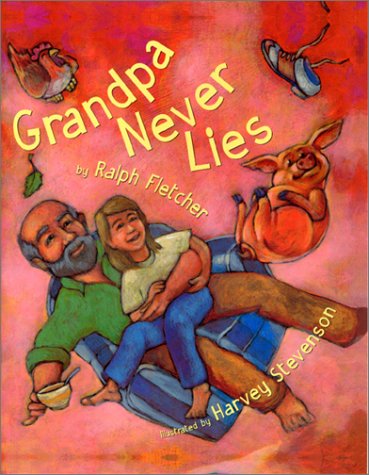
As an example, Ralph shared his wonderful picture book Grandpa Never Lies. He then recounted a classroom lesson he had observed about that very book, and how the teacher had used the analogy of a snowball rolling downhill, growing ever larger as it progressed. The recurring line of the book acted in much the same way, growing with importance each time it was repeated.

Such a concept is easy to study in the context of a picture book; so much harder to extrapolate from the noise and confusion of a novel.

Touchstone Texts

Deb Renner Smith talks about Touchstone Texts at her Writing Every Day Works blog, and provides a number of professional reading recommendations for those who'd like to learn more about them. Some great resources there!

Content Area Reference Books


When tackling research projects in the elementary and middle grades, students can find a wealth of information in content area reference books, aka nonfiction picture books. Why tempt students to simply cut and paste online when nonfiction picture books provide so many organizational conventions which they'll need for success with texts in the upper grades? Good content area reference books contain a table of contents, an index, a glossary, headings, captions, illustrations, margin notes, and graphic aids such as tables, charts, and time lines. Familiarity with these text attributes will definitely transfer over to comprehending textbooks later on.

What's also nice about picture books is that the same topic can be accessed on so many different reading levels. Beginning readers will appreciate Usborne Beginners simple Knights while more advanced readers would enjoy The Usborne Book of Castles, complete with all the standard nonfiction conventions listed above, plus Internet links, maps, cut-away diagrams, and a gazetteer.

In Conclusion

If you're writing or mapping curriculum, communicating with parents or administration, or seeking a grant, I hope this list of picture book euphemisms will prove helpful.

Have another I don't know? Leave a comment below.

Monday, December 27, 2010

Basic Literacy Skills Through Picture Books

How can educators help students without basic literacy skills succeed?

Picture books.

I've even created a video that explains the many ways they can do that.


Saturday, April 17, 2010

Picture Books on Teacher Talk Radio

This past Thursday I had the opportunity to be a guest on Teacher Jen's Teacher Talk Radio.

Check out our discussion on using picture books in the classroom, and be sure to check out Jen's upcoming episodes and archive of previous broadcasts. In addition to listening live, you can also download episodes for free from itunes. If you're on Twitter, follow Jen so you don't miss out on any upcoming guests.

Saturday, February 27, 2010

Recommended Picture Books for Black History, Part II

This post is way overdue! But the fact is, the books I'm about to share are great for any time of the year, and certainly need not be limited to Black History Month. Be sure to also check out Part One of this post for more great ideas!

George Crum and the Saratoga Chips, written by Gaylia Taylor and illustrated by Frank Morrison, is a terrific tale of invention. Having always felt like an outsider because of the color of his skin, George Crum thinks he's finally found in his place as chef at a prestigious Saratoga Springs restaurant. But when a customer's complaint makes him feel inferior, his inventiveness helps to create one of America's finest "delicacies," now enjoyed in almost every American home.

Students, of course, love to create, so some exercises in invention are in order as an extension to this fun book. There tons of sites on invention, but I'm a teacher, and I know you don't want messy, time-consuming projects to litter your classroom! Here instead are a few simple, neat web links to explore:
  • African American Inventors is a site designed for upper grade students, but can be easily navigated with just a little assistance. There students can research achievements of an assigned Black American. If you need a few names to get started, see Cengage Learning's Invent-O-Rama page.
  • Meet Me at The Corner is a cool virtual field trip site, and their video on Kid Inventors' Day is supplemented with some simple follow-up questions and activities.
  • Whizzball allows students to either solve or create a pathway of gadgets to move a ball from one place to another in a Mousetrap-like environment. Extremely open-ended and adaptable to many skill levels.
  • The History of Invention is a cool invention timeline which can be scrolled either vertically or horizontally. There students can learn about the origins of the "stuff" they use every day.
Jimmy "Wink" Winkfield is the inspiration behind The Last Black King of the Kentucky Derby, written by Crystal Hubbard and illustrated by Robert McGuire. Jimmy Winkfield is the only black Jockey to win two Kentucky Derby titles back to back, and for this honor was inducted into the National Museum of Racing Hall of Fame in Saratoga Springs. This book chronicles his determination to win on and off the track in the face of increasing racism in the world of horse racing.

Muhammad Ali: Champion of the World, written by Jonah Winter and illustrated by Francois Roca, tells the tale of the man who would be King, not on the race track, but in the boxing ring.

This is the true Ali: proud, controversial, devastating. Roca's thick, sculpturesque paintings are the perfect complement to Winter's narrative, which echoes the language and rhythm of the Book of Genesis. All in all, a satisfying, fact-filled tribute to the Champion of the World.

Be sure to check out Ali's complete biography, as this book is certain to prompt questions from many students. From Ali's own official site, you'll find many video segments of his greatest fights.

Willie and the All Stars, written and illustrated by Floyd Cooper, is one of that author's finest titles. While many of us know Floyd Cooper as simply an illustrator, providing beautiful images for the words of others (as in Brown Honey in Broomwheat Tea, by Joyce Carol Thomas), Willie and the All-Stars establishes Cooper as a double threat talent.

Young Willie dreams of playing professional baseball one day, but is dissuaded from pursuing that dream because, after all, Blacks don't play in the major leagues in 1942 America. He's close to giving up hope until one day a neighbor gives him tickets to an exhibition game between Negro League and Major League All-Stars at Wrigley Field. The Negro League players, led by Satchel Paige and Josh Gibson, quickly impress the crowd with their determination playing style, and through their grit edge the much-favored major leaguers for the win. The book ends with a glimmer of hope for Willie and boys like him as white and black players shake hands on the field at game's end. An author's note adds a bit of history regarding the Negro Leagues.

This book would, of course, be a perfect companion title to Let Them Play, mentioned in my Recommended Picture Books for Black History Month, Part I post. Let Them Play details the struggle of young players which mirrored those of their idols.

Following a reading of Willie and the All Stars, students may wish to explore the history of Negro Leagues. A good place to start would be Carole Boston Weatherford's A Negro League Scrapbook or Kadir Nelson's excellent We Are the Ship. See my Going Extra Innings with Baseball Picture Books post for questions, lessons, and more online extensions.

For further research and activities, you'll find everything you need at the Negro Baseball League site at 42Explore (Four to Explore). Using the resources there, students can create a baseball card, player biography, or team poster, or complete a webquest on Negro Baseball.

Wednesday, January 13, 2010

Coming Attractions: Book Trailers

I wrote about book trailers at my How to Teach a Novel blog, and the response from teachers was extremely positive. Like a movie trailer (aka movie preview), a book trailer provides just a glimpse of the overall story, with plenty of visuals and just enough hook to draw in the viewer (or, in this case, the reader).

Dr. Mark Geary has collected a terrific list of picture book trailers to get you started. You'll find lots of new and old favorites there (for example, Tuesday by David Wiesner; Diary of a Worm and Click, Clack, Moo: Cows That Type by Doreen Cronin; Sarah, Plain and Tall by Patricia MacLachlan, and The Whipping Boy by Sid Fleischman).

If you dig these and want more, YouTube has several, searchable by name and (not as often) by author or publisher. Publishing houses offer them as well, and most publishers provide search functions to help find them. The Scholastic site, for example, has over sixty terrific, professionally published videos. You can also check out my recent series on Publishers' Resources: parts I, II, III, and IV to see which children's publishers provide videos.

The video below shows how music, movement, and selected text can create anticipation for Farmer George Plants a Nation, written by Peggy Thomas and illustrated by Layne Johnson.


If you're a middle grade or high school teacher, definitely check out the Scholastic site, and also take a look at 60 Second Recap, a hip new site which breathes life into high school classics.

Suggested Uses for Book Trailers

So how can classroom teachers make the best use of these videos?
  • Book trailers can create a sense of anticipation for an upcoming novel or even picture book. A teacher can whet appetites for the next day's reading by showing a book trailer at the end of each day.
  • By their short nature, book trailers provide a clear model of summarizing. Trailers may additionally provide models of other literary techniques including cliffhangers, foreshadowing, mood, pacing, and tone.
  • Prior to the introduction of a novel, the trailer is an alternative way to provide a general story outline, apart the back cover blurb. This allows students to focus less on the overall "story line" and to concentrate more intently on literary elements. After seeing a preview for a movie, we often feel that we can predict the entire movie's story line, yet we go to see it anyway. Why? Because we want to fill in the gaps that the preview intentionally created. We also want to enjoy the visual elements, the witty banter, the twists and turns that the trailer only hinted at.
  • When using a novel as a mentor text, a trailer can scaffold the overall story line. How is that different than the idea above? When teaching my students the importance of using alternatives to "said," for example, I assigned pairs of students two chapters from Gordon Korman's Swindle. Korman is a master at crafting realistic dialogue, and in one chapter alone a student found thirty speaking words other than said, and the word said itself was used just five times (and most often with an adverb). Although students only skimmed to collect the words, they still wanted to get an idea of the overall plot (some students, after all, were assigned Chapters 15 and 16, pretty deep in the action!). The Swindle trailer not only helped students see how their chapters tied into the overall story, it also encouraged over a dozen of them to sign out the book that day.
  • Trailers can be used to build critical thinking skills. Allow students to compare the books to their trailers, guiding the discussion with questions such as Did the trailer give you the same feeling as the book itself? Do you feel that the narrator was right for the video, and why or why not? What did the trailer leave out? Why do you suppose those elements were chosen? For what audience is this trailer intended: teachers, librarians, parents, students, booksellers, others? How do you know? What would you change in this trailer and why?
  • In some cases, students can even compare one trailer to another for the same book. This alternative book trailer for Swindle can be found on YouTube. What are the strengths and weaknesses of each? Which segments from each could be combined to make a new trailer that's even better than either of the originals?
Have your own source for book trailers, or other ideas for using them in the classroom? Email me or leave a comment below.

UPDATE: My new Twitter friend Tara Lazar (@taralazar) pointed out that there's now a Kids' Lit Book Trailer Ning. How cool is that? Thanks, Tara. See? Twitter is a good thing!